
Sleep and bedtimes in foster care: what actually helps
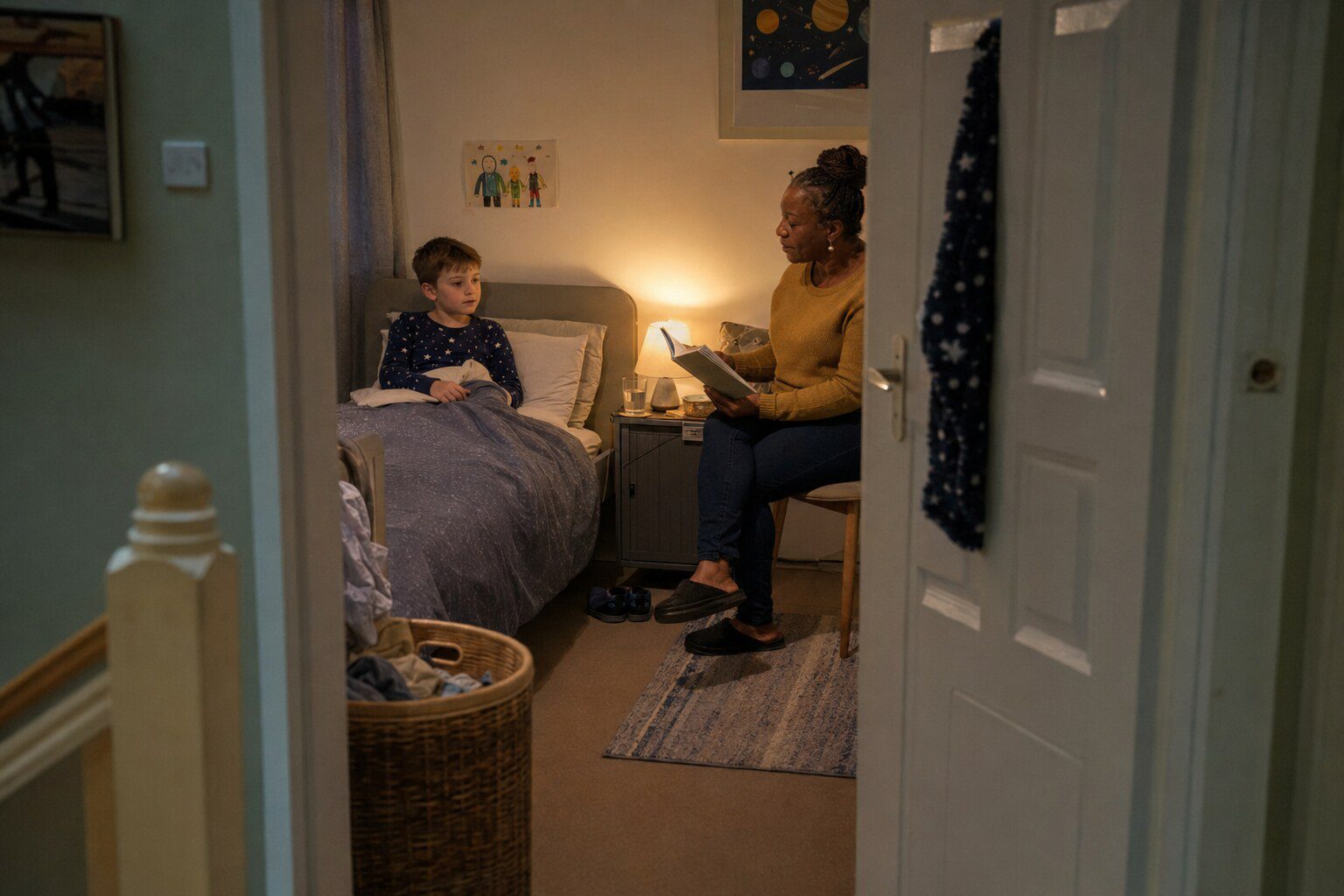
Most foster carers meet the sleep problem in the first week. The child is exhausted, you are exhausted, and none of the bedtime advice you have read seems to touch it. Here is what works, what to stop doing, and when broken sleep is a health matter rather than a routine to fix.
Please note: general information for carers, not medical advice about a particular child. Correct at November 2026, drawn from NICE’s guideline on bedwetting in under 19s, NHS sleep guidance and The Lullaby Trust. Speak to a GP if you are worried about a child’s breathing at night, or if a child who was dry starts wetting the bed again.
The first few nights are the hardest, and that is not a sign it is going wrong
A child arrives with a rucksack, and by nine o’clock you are on the landing wondering why a seven year old who can barely keep their eyes open will not lie down. Bedtime is the moment in the day when a child has to stop watching. For a lot of children who come into care, the dark used to be the least safe part of the day: the hour when the adults changed, when noises meant something, when nobody came. Falling asleep means giving up the one job they have got good at.
So the resistance is rarely defiance, and it is not a verdict on your home. It usually means the child does not yet know what happens in this house at two in the morning. Nearly every piece of sleep advice written for tired parents assumes the child already trusts the house, and a child in their first fortnight has not got there yet, however carefully you prepared the room before they arrived.
How much sleep a child actually needs
Worth knowing before you decide there is a problem at all. NHS guidance, counting naps for the younger ones:
- babies from four months to a year: 12 to 15 hours
- one to two years: 11 to 14 hours
- three to five years: 10 to 13 hours
- six to 13 years: 9 to 11 hours
- teenagers: 8 to 10 hours a night
Treat that as a net, not a scorecard. A child who gets nine and a half hours and wakes up cheerful is fine. What matters is whether the shortfall shows up the next day, and sleep debt in a child seldom looks like yawning. It looks like behaviour that is hard to handle: nothing landing at school, and a short fuse by four in the afternoon.
The boring routine is the thing that works
None of this is clever, which is exactly why it gets skipped.
- the same bedtime every night, Fridays included, and an order of events the child can predict, written down or drawn if that helps
- twenty minutes of wind down before lights out: a warm bath and a book, nothing with a screen in it
- phones, tablets, the TV and anything else with a screen away thirty to sixty minutes beforehand, and out of the bedroom overnight
- a dark, quiet room at around 16 to 20C, with a red or orange nightlight if the child wants one
- no caffeine, which means the energy drinks a teenager brings home as well as the tea
- proper exercise during the day, outdoors if you can manage it
The phone rule starts arguments, and it is worth having the argument. A 14 year old scrolling at midnight is often awake because of what they are looking at online, not merely losing an hour. And if a child is hungry at bedtime, feed them. Sending a child up hungry to protect a routine is a bad trade.
When the bedroom itself is the problem
Some children cannot be alone in a room with the door shut, and telling them they are safe does not shift it. Let them have whatever makes the room bearable: more light than you would ever use yourself, the door wide open, their own bedding from before. None of that is spoiling a child, and the light can come down by degrees over a few weeks.
Then move slowly. If you have been sitting on the end of the bed until they drop off, work your way out over several weeks: end of the bed, then a chair by the door, then the landing, then another room. Check the plan with your supervising social worker first, because anything involving a child’s bedroom at night belongs in your safer care agreement, not invented on the spot at half past eight.
If a child tells you there are monsters in the room, find out what the monsters are before you reassure them away. Sometimes it is monsters, and monster-proofing the room together is a good evening’s work. Sometimes it is a way of telling you about a person, which is where trauma and attachment stop being theory. Your job is not to work out what a child is. It is to be someone safe enough to be told.
If you are fostering a baby, they sleep in your room
This part is not a matter of preference. The Lullaby Trust’s safer sleep advice is that a baby sleeps on their back, in their own clear, flat, firm sleep space, in the same room as you for at least the first six months. A cot or a Moses basket, a firm flat waterproof mattress, lightweight bedding, and nothing else in there: no pillows, no duvet, no bumpers, no soft toys, nothing weighted. Room at 16 to 20C, and no smoke.
There is a recruitment point buried in that, and it surprises people. Because a baby under two can sleep in a cot in your own room, a spare bedroom is not always the thing standing between you and fostering. We are actively looking for people who want to care for babies. For a baby under a year, your health visitor is the right first call rather than a sleep helpline.
Bedwetting, and the two things most people get wrong
Bedwetting is common in the first weeks after a child moves in. Two pieces of received wisdom about it are actively unhelpful, and NICE’s guideline on bedwetting in under 19s says so plainly.
The first is cutting back drinks. Restricting fluid through the day makes bedwetting worse, not better, because a bladder that is never full does not learn to hold a normal volume, and NICE is clear that adequate daily fluid intake matters. ERIC, the children’s bowel and bladder charity, gives the practical version: plenty to drink spread evenly across the day, then stop drinks about an hour before bed. Cut the caffeine, not the water.
The second is the sticker chart for a dry night. A child cannot decide to be dry, so rewarding dryness rewards luck and quietly blames a child for their own bladder. NICE says to reward what the child can actually control, such as drinking enough during the day or going to the loo before bed.
Two more. Do not lift or wake a child in the night to carry them to the toilet: NICE found that neither waking nor lifting promotes long term dryness. And never let a child feel ashamed of a wet bed. Keep a mattress protector on and spare bedding within arm’s reach, so a two o’clock strip-down is a five minute job.
Nightmares, night terrors and sleepwalking are not the same thing
A nightmare is a bad dream the child remembers, and the memory can make the next bedtime frightening. Talk about it, and if it traces back to a film or a book, help them put the pictures down. The same nightmare on repeat is worth mentioning to your supervising social worker.
A night terror is a different animal. The child looks awake, may scream or thrash about, and is asleep throughout. So is sleepwalking. Do not wake them. Stay close enough to keep them safe, steer a sleepwalker gently back to bed, and gate the stairs if you need to. Most children grow out of both. If episodes come at roughly the same time each night, gently waking the child about fifteen minutes beforehand can break the pattern.
Two things are medical rather than behavioural, and no bedtime routine will touch them. If a child snores loudly and irregularly, pauses in their breathing, or gasps and chokes in their sleep, ask the GP about sleep apnoea. The health assessment a child in care has, first within 20 working days of coming into care and then six-monthly under five or yearly from five, is the right place to raise that or anything to do with a child’s mental health. Sleep is a health matter and it does not have to wait for a crisis.
You won’t have to do this alone
Broken sleep in a child turns into broken sleep in the adults, fast, and a carer running on four hours is not a safer carer. Say so early, to your supervising social worker, before it becomes the reason you are thinking about stopping. Week three is a much better conversation than week twelve.
At Greater London Fostering you get a supervising social worker who knows your household and your bedtimes, and out of hours support for two in the morning when you have run out of ideas. GLF pays 479.50 pounds a week for a child under 11 and 507.50 pounds a week for a child aged 11 or over, per child, for as long as they are living with you, with an enhanced fee of roughly 100 to 200 pounds a week more where a child has higher needs. Ofsted inspected us from 21 to 25 July 2025 and rated us Outstanding in all three judgements.
Two numbers for the kitchen drawer. The Sleep Charity’s National Sleep Helpline is 03303 530 541, open Monday and Wednesday 9am to 11am and Tuesday and Thursday 7pm to 9pm, for carers of children aged 12 months and over. ERIC’s freephone bedwetting helpline is 0808 801 0343, Tuesday to Thursday 10am to 1pm.
If you have a spare room, or a cot that would fit in the corner of yours, we would be glad to talk it through. No pressure, no obligation.
Or read more about becoming a foster carer.
Frequently asked questions
A child in my care keeps getting out of bed. What do I do?
Be dull and consistent. Take them back with as little talk and light as possible, because the aim is not to wake them further. With younger children, going back at longer gaps often works: one more goodnight after a minute, then three, then five, then ten. Praise a good bedtime the next morning.
Can I give a child melatonin to help them sleep?
Not on your own initiative. Melatonin is a prescription medicine in the UK, so it is a doctor’s decision, and NHS prescribing guidance says sleep hygiene and behavioural approaches come first. Never buy it online. You also need consent before giving any medicine to a child in your care, so the route is your supervising social worker, then the GP.
How long before a child settles into a normal bedtime?
Usually a few weeks, sometimes a few months, rarely in a straight line. Expect it to wobble around family time, or anything that reminds a child of an earlier move. A fortnight of going backwards is not a sign the routine has failed.