
Supporting an LGBTQ+ Young Person in Foster Care
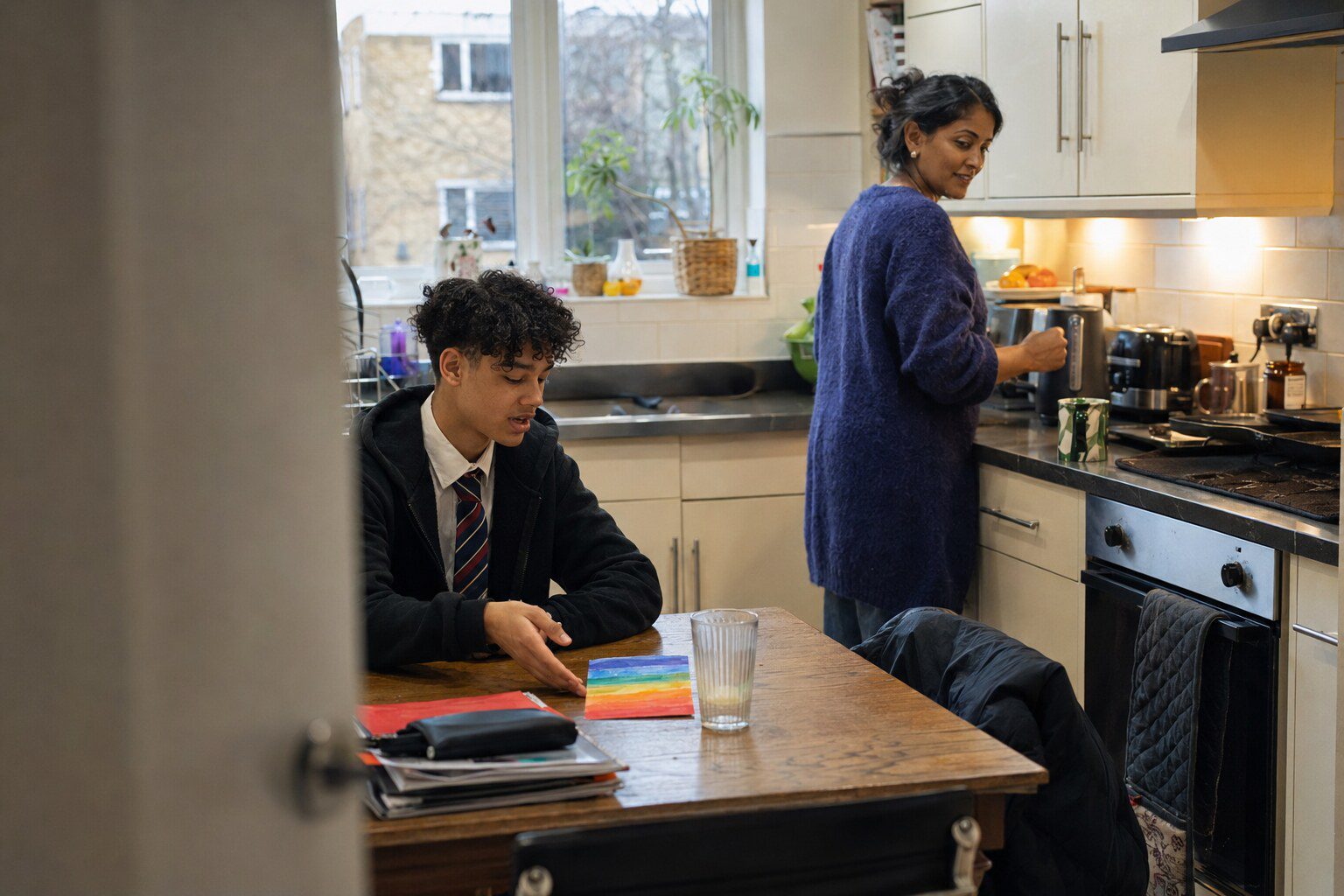
This is one of the things people quietly worry about before they enquire. What if a young person in my home is gay, or bi, or tells me they are not the gender everyone assumed? What if I say the wrong word and make it worse? You need far less specialist knowledge than you think, and rather more patience with your own discomfort.
Please note: general information for people thinking about fostering, not advice about a particular child. Anything to do with a specific young person runs through their care plan and their social worker. Correct at 11 September 2026. The school guidance below is Keeping Children Safe in Education; NHS referral routes are set by NHS England.
Most of this is not about being LGBTQ+ at all
A young person who has come into care has usually already learned something hard: that adults can be unpredictable, and that telling the truth about yourself sometimes costs you. So they arrive with a skill. Within a fortnight they will have worked out which adults in the house are safe, and which ones go quiet when certain subjects come up. Everything else sits on top of that.
Which means the day to day is mostly ordinary. Nagging about the shower, the bus pass that has gone missing again, whether Friday counts as a school night. What changes a young person’s week is not your vocabulary. It is whether they think you would still want them at the table on Sunday.
Your job is not to work out what a child is
Some older training material, including some of ours, used to hand carers a list of signs to watch for: clothes, haircuts, which artists they listen to. Put no weight on any of it. A boy who likes musicals is a boy who likes musicals. The real trouble is what using a list like that does to a young person. Acting on a guess tells them you have been watching and drawing conclusions, which is what makes someone decide you are not safe to tell.
So here is the position this agency takes. Your job is not to work out what a young person is. It is to be someone safe enough to be told, and that is built from small ordinary moments rather than one big conversation. In practice:
- Keep your everyday language open before you have any reason to think it matters. “Is there anyone you like at the moment?” assumes nothing.
- Let a same-sex couple in a soap pass without comment, or with an ordinary one. Young people read your face.
- Don’t go fishing. A leading question puts a young person on the spot and usually gets you a lie.
- Never tell anyone on a young person’s behalf, even to smooth the way. It is theirs to tell, to whoever they choose.
- If you do not know a word, look it up later. They are fifteen and they are not your tutor.
If a young person does tell you
The first thirty seconds do most of the work, and you do not need a script. Thank them. Say nothing has changed. Ask what they would like to happen next, then do that rather than what you had in mind. What you are aiming for is slightly boring: the conversation ends, and the evening carries on as it would have anyway.
Things that land badly: a big speech, “I always knew”, a rush of questions about who else knows, and any version of a carer needing to be comforted. You may well feel something strong. Take it to your supervising social worker, not to the young person.
Being lost for words is not a disqualification. Plenty of good carers have no vocabulary for this and are quietly terrified of getting a term wrong. A slip you notice and correct costs a young person almost nothing. Steering away from the subject to stay safe costs them far more.
Who gets to know, and who does not
You are not a friend keeping a secret, and you are not a noticeboard. Both get carers into trouble. As a foster carer you have recording duties, and the honest line is that you record what happened, not what you think a young person is. “Told me about a friend at school and seemed anxious” is a record. “I think she might be gay” is a guess in a file that will still exist when she is forty.
If something does need to go further, say so first, and say why. Most young people mind far less about a social worker knowing than about finding out afterwards. If somebody else asks, “I wouldn’t want to speak for them” is a whole answer.
Family time needs its own thought. Ask the young person what they want used when they see their family, including which name, and follow their lead. Anything that looks like a safeguarding concern goes to your supervising social worker rather than being handled at the front door. Our guide to how family time actually works covers the practicalities.
School, and what you can actually ask for
School is where most of this gets difficult, and where a foster carer has more say than they realise. Every child in care has a designated teacher at their school and a virtual school head at the local authority, and both sit behind the Personal Education Plan. The PEP is a meeting you attend and a document you can have things written into. Worth raising there:
- Whether there is one adult in that building the young person would go to, and whether that adult knows it.
- How the anti-bullying policy works in practice, and what happens the second time rather than the first.
- What happens in lessons where this comes up, and around PE.
From September 2026, Keeping Children Safe in Education, the statutory safeguarding guidance schools in England must follow, includes guidance on children questioning their gender, covering how requests are handled and how single-sex facilities are used. Applying it is the school’s job, not yours. Yours is to ask how their policy works before there is a problem, and to get the answer into the PEP. Our article on what you can ask a school for covers the rest of that ground.
Health is not your decision to make
This is the part carers worry about most and have the least say in. Health decisions for a child in care run through their social worker, whoever holds parental responsibility, and their clinicians. A foster carer does not hold them and should never appear to.
Two facts are worth having. Referrals to NHS children and young people’s gender services in England come only from NHS paediatric services or children and young people’s mental health teams, so a carer cannot refer directly, and waits have been running at around three years. Restrictions on the private supply of puberty-suppressing hormones to under-18s came into force on 1 January 2025. If you have read older training material on any of this, check the date on it. Very little written before 2024 is still accurate.
What is yours: a GP who treats the young person decently, and saying something when a professional is dismissive. Our guide to supporting a young person’s mental health is the better starting point for the rest.
When it goes badly
Some young people arrive having already been turned away once, by people who were supposed to love them whatever happened. That tends to produce a young person who pushes hard to find out whether you will do the same, often at the worst moment and over something that looks unrelated. The answer is not a speech about how you never would. It is turning up the next morning exactly as you did the morning before.
Numbers worth having written down. Childline is free on 0800 1111 for any child, with pages written for young people on sexuality and gender identity. akt supports LGBTQ+ people aged 16 to 25, including care-experienced young people getting ready to move on, with live chat from 10am to 5pm on weekdays. One warning: several well-known LGBT+ helplines are adults only, so check the age range before handing a number to a teenager. Our piece on fostering a teenager is worth reading alongside this.
You won’t have to do this alone
None of this is meant to be worked out alone at eleven at night. Every GLF carer has a supervising social worker who knows their household properly, and someone is on the phone at any hour. Training is ongoing rather than a one-off, and a fair amount of the useful stuff comes sideways from other carers who have been here before. If a young person comes out to you tomorrow, the first call you make is to us, and nobody expects you to have handled it perfectly.
GLF pays one fixed weekly fee covering both the allowance and your reward: 479.50 pounds a week for a child under 11 and 507.50 pounds for a young person aged 11 or over, paid per child while they live with you, with an enhanced fee of roughly 100 to 200 pounds a week more where the needs are higher. Ofsted inspected us in July 2025 and rated us Outstanding in all three judgements. Our guide to the support foster carers receive covers what else comes with the role.
If you have questions you would rather not type into a search box, ask us instead. No pressure, no obligation.
Or read more about becoming a foster carer.
Frequently asked questions
If a young person comes out to me, do I have to tell their social worker?
Usually something does need to be shared, because it may affect their care plan, their school and family time. What protects your relationship is telling the young person first: what you are passing on, to whom, and why. Record what happened rather than your conclusions.
Can I foster if my faith means I have questions about this?
Yes, and plenty of our carers hold a faith. Your assessment explores how you would care for a young person whose life looks different from your own, which every carer gets asked in some form. The requirement is that a young person in your home is safe and is never made to feel there is something wrong with them, not that you hold particular views.
What if the young person’s family reacts badly during family time?
Raise it with your supervising social worker rather than managing it yourself in a car park. Family time arrangements can be changed, and what gets used during a visit, including names, is something the young person should have a say in. Your job in the moment is to stay calm and take them home.