
Fostering a Child With FASD: What Actually Helps
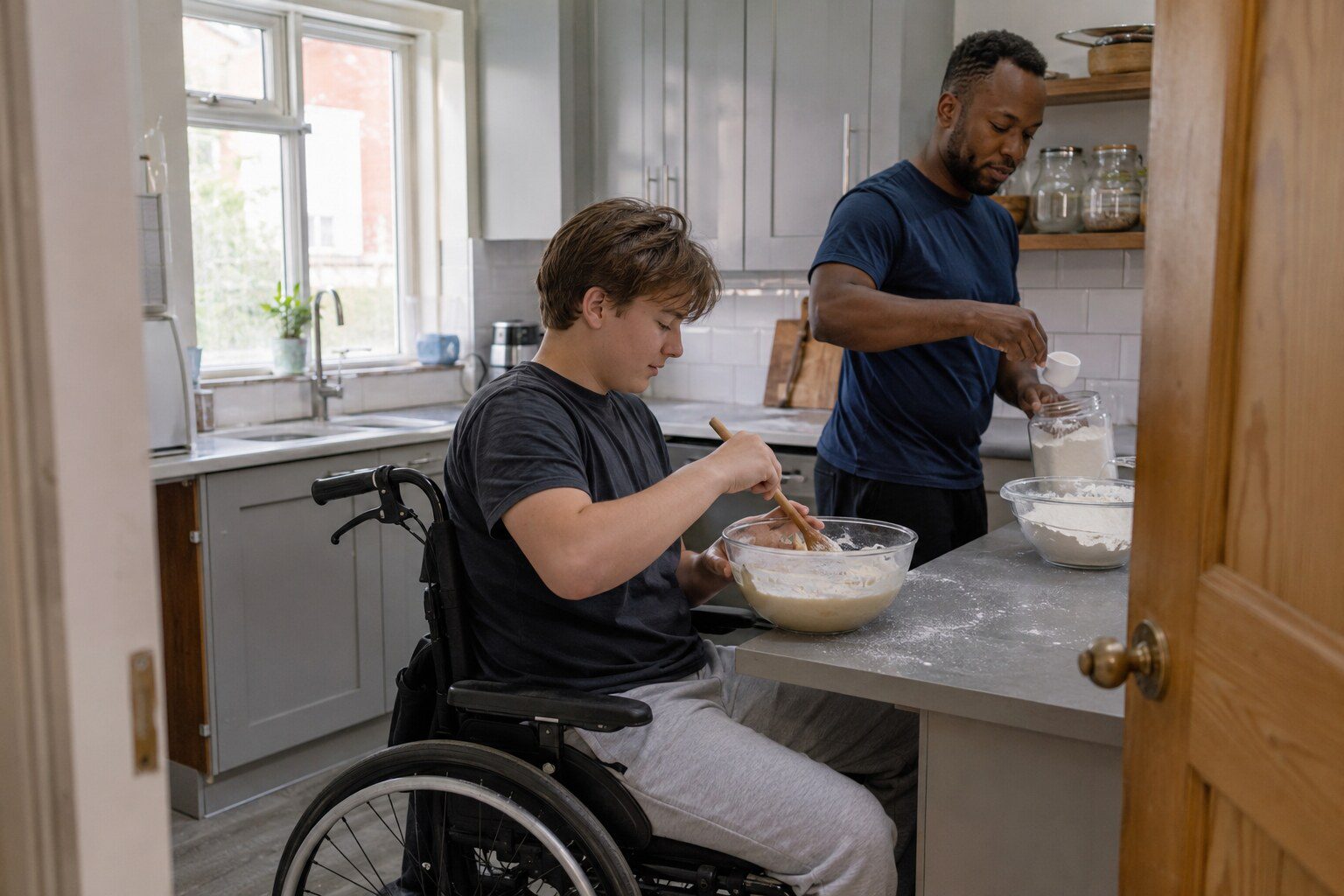
Foetal alcohol spectrum disorder is probably the most common condition you have never been trained to spot. It is also one of the most misread, because a child with FASD often looks like a child who is being deliberately difficult. They are not. Here is what the condition actually does, what helps, and the one approach that reliably makes it worse.
Please note: This is general information, not medical advice about a particular child. It is correct at 6 November 2026. Diagnosis and assessment in England follow NICE quality standard QS204, published 16 March 2022. Anything about a child in your care should go through your supervising social worker and the child’s GP.
What FASD is, in plain terms
Alcohol crosses the placenta. When a developing baby is exposed to it, the damage can land on the brain, and that damage does not heal later. FASD is the umbrella name for the range of difficulties that follow. The NHS position is that there is no known safe amount of alcohol in pregnancy, which is why the first of NICE’s five quality statements is simply that pregnant women are given advice throughout pregnancy not to drink.
The single most useful thing to hold on to is this: FASD is a brain injury that happened before birth. It is not a parenting failure, not a phase, and not something the child can be talked out of. Everything that works follows from taking that seriously.
It is worth saying plainly that the women involved are not villains here. Many did not know they were pregnant, many were drinking to cope with what was being done to them, and many were never told there was a risk. If you go on to support family time, your view of the child’s mum will show in your face whether you intend it to or not.
Nobody actually knows how common it is
You will see a lot of confident numbers. Treat them carefully. The government’s own FASD health needs assessment, published 9 September 2021, says flatly that “there are currently no prevalence studies for FASD in the UK”. What exists is a set of estimates that disagree:
- A global modelling study put the UK at 32.4 cases per 1,000 people, about 3.24%, with a confidence interval running from 2% to 4.9%. It relies on self-reported drinking, which people under-report.
- An active screening study in three Greater Manchester primary schools found 1.8% of children had FASD. It was cut short by covid and never completed.
- Applying the diagnostic criteria retrospectively to an existing birth cohort produced a screening range of 6% to 17%, which the same document warns “may be significantly higher than actual prevalence”.
- A local audit found the figure rose to around 27% for children in care, against roughly 3% in the general child population it compared against. One audit, not a national study.
So the honest summary is that FASD is a lot more common among children in care than in the general population, that it is widely missed, and that anyone quoting you a precise national figure is guessing. That uncertainty is not a reason to ignore it. It is a reason to ask the question when a child arrives and nobody has asked it before.
What you might notice
Fewer than one in ten people with FASD have the facial features most people have heard of. NICE describes them as short palpebral fissures (smaller eye openings), a smooth philtrum (the groove between nose and top lip is flattened) and a thin upper lip. If you are waiting to see those before you take the possibility seriously, you will miss almost everyone.
What you are far more likely to notice is a mismatch. A bright, chatty eleven-year-old who cannot get dressed in the right order. A child who explains the rule perfectly and breaks it twenty minutes later. A teenager who reads well and cannot manage money or time. Under UK guidance, which follows SIGN 156, a diagnosis needs severe impairment in three or more areas of brain function: motor skills, memory, language, attention, executive function, emotional regulation, academic achievement, and everyday skills like getting ready for school on time.
One quirk catches carers out badly. Memory gaps often get filled in with invented detail, so a child may tell you something that did not happen and believe it. That reads as lying and gets punished as lying. It usually isn’t.
Getting an assessment, and what you can bring to it
NICE says children with probable prenatal alcohol exposure and significant physical, developmental or behavioural difficulties should be referred for assessment, and that those with confirmed exposure, or all three facial features, should have a neurodevelopmental assessment where there are clinical concerns. In practice the route starts with your supervising social worker and the child’s GP.
You can make that referral much stronger. Bring:
- Any evidence of alcohol exposure during pregnancy, which for a child in care often sits in records the local authority already holds rather than with you.
- Photographs of the child as a baby or toddler, unsmiling if you have them, since smiling changes the upper lip.
- Written observations from school about what the child cannot do, not just how they behave.
- Your own dated notes of the specific things that go wrong, in ordinary language. “Asked three times to put shoes on, did not start, no defiance, seemed to have lost the thread” is worth more than “non-compliant”.
Assessment pulls in several professions at once, which is part of why waits are long. Push anyway. NICE’s fifth quality statement is that a child with a diagnosis has a management plan, and a plan is what makes school, health and the local authority act in the same direction.
What helps day to day
None of this is dramatic. It is the same small things done the same way for a long time, which is exactly why it works on a brain that struggles to hold new patterns.
- Keep the day predictable, and give warning before anything changes. Repetition is not nagging here; it is the support itself.
- Cut instructions down to one step. “Shoes on” lands where “get ready, we’re leaving in five minutes” does not.
- Use pictures. A strip of cards for the morning routine does more than any amount of reminding.
- Say what you want rather than what you don’t. “Clothes in the basket” beats “stop leaving your clothes on the floor”.
- Parent the developmental age in front of you, not the birthday. A fourteen-year-old may need the scaffolding you would give a seven-year-old in some areas and none at all in others.
- Head off the predictable flashpoints. If the big supermarket on a Saturday always ends badly, go on Tuesday or go alone.
- Watch for sensory triggers. Seams in socks, a noisy hall, a smell in the kitchen. Small adjustments, large returns.
Teach the child about their own condition too, at whatever level fits. A young person who understands why some things are harder can start asking for help instead of concluding they are stupid. The National Organisation for FASD runs Me and My FASD, written with input from young people who have it, which is a reasonable place to start.
The approach that reliably makes things worse
Consequences. Not because children with FASD should face no expectations, but because the standard behaviour toolkit assumes a working link between action, consequence and future choice. In FASD that link is often the damaged part. Take away the tablet on Tuesday for something that happened on Monday and you have taught the child that adults are unpredictable and punishing. You have not taught them anything about Monday.
This is the hardest adjustment for experienced carers, because sticker charts and lost privileges have worked for every other child they have looked after. Drop them. Change the environment so the thing does not happen, and accept that you will be doing the remembering for both of you for a long time. Our guide on what helps when a child’s behaviour is hard to handle goes into this further, and much of what works for an autistic child transfers across, since FASD frequently sits alongside other neurodevelopmental conditions.
You won’t have to do this alone
A child with FASD needs a household that can hold a routine for years, not a carer with a special technique. That is a reasonable thing to ask of an ordinary family. Your supervising social worker can push for assessment and get FASD written into the personal education plan, so school stops treating forgetfulness as attitude. Our articles on fostering a child with additional needs and getting a school to do the right thing cover the next steps.
Fostering a child with higher needs is also paid at a higher rate. Our carers receive 479.50 pounds a week for a child under 11 and 507.50 pounds a week for a child aged 11 or over, paid per child while they are with you, with an enhanced fee of roughly 100 to 200 pounds a week more where needs are greater. It is one weekly amount covering the child’s costs and your fee, set out in full on our page about how our fostering pay works.
Ofsted inspected us from 21 to 25 July 2025 and rated us Outstanding in all three judgements. For FASD specifically, the National Organisation for FASD is the main UK charity and takes calls on 0208 458 5951.
Not sure whether you could look after a child with needs like these? Ask us. No pressure, no obligation.
Or read more about becoming a foster carer.
Frequently asked questions
Will I be told if a child was exposed to alcohol before birth?
Sometimes, and often not, because the information may never have been recorded or the pregnancy may have had little medical oversight. Ask directly at the planning meeting and ask again later, since records catch up. Where there is no evidence either way, a child can still be assessed and may be recorded as at risk rather than given a diagnosis.
Is FASD just ADHD by another name?
No, although they overlap a great deal and many children have both. The practical difference is that some of the strategies that help with ADHD assume the child can learn from consequences over time, and with FASD that assumption often does not hold. If a child has an ADHD diagnosis and the usual approaches are not working at all, FASD is worth raising.
Does a diagnosis need the facial features?
No. UK guidance recognises FASD both with and without the sentinel facial features, and fewer than one in ten people with FASD have them. A diagnosis without them rests on confirmed alcohol exposure plus severe impairment in three or more areas of brain function.